|
|
Policing under Section 1983: The Year in Review
SKU: CIVR1200
- Instant Online Access
- All Your Devices
- DVD & CDs
- iOS & Android App
- Save To Device
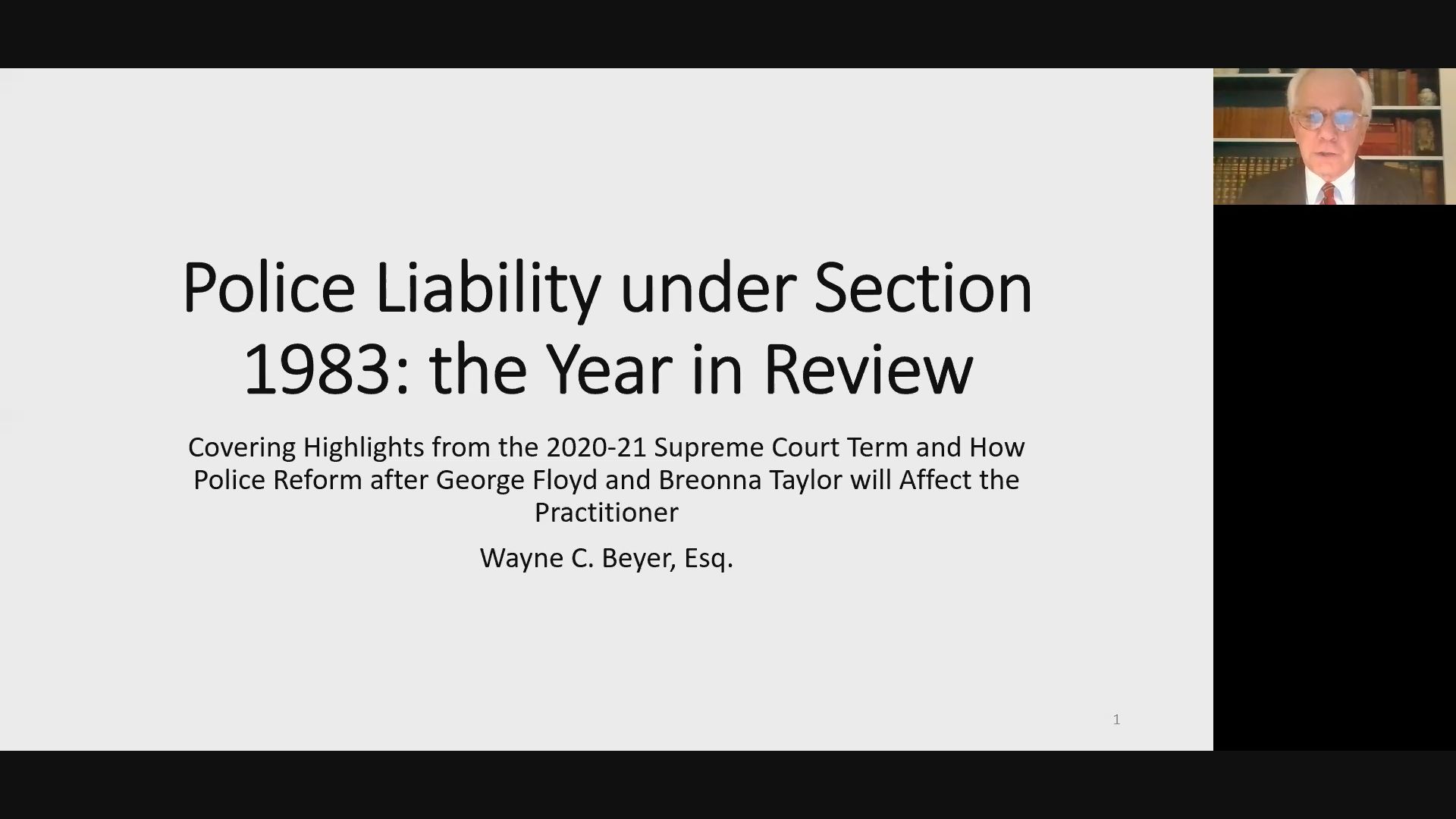
The past few years have been a monumental one for policing in America. Get on top of the developments that will affect your practice. First, a review of the Supreme Court’s term: residential searches under Caniglia v. Strom; residential arrests under Lange v. California; and intent to restrain as a seizure under Torres v. Madrid.
Next, the top ten ways policing after George Floyd and Breonna Taylor will affect your practice: from qualified immunity, choke holds, and no-knock warrants; to de-escalation, mental health calls and failure to intervene; to reforms in training and transparency in discipline; and changing concepts in law enforcement itself. All this, plus links to use in your practice.
Take-aways that will help your practice
- Supreme Court’s term in review: limitations on residential searches and arrests, but an expansion of what is a seizure
- Reforms that would limit qualified immunity, neck restraints, no-knock warrants, pursuits, shooting at vehicles, and require de-escalation of force and intervention
- Training models that integrate assessment, communications and tactics and replace the use of force continuum and 21-foot rule
- Discipline that involves early warning, citizen review boards, public hearings and access to disciplinary records
- First Amendment, the right to protest, new concepts in crowd control
- Legalization of drug possession and what that means to motor vehicle stops, searches and arrests
- Future of policing
Wayne C. Beyer, Esq.
Wayne C. Beyer is a litigator, author, presenter, and former administrative appeals judge. He has been lead counsel in 300-350 police misconduct and corrections cases, including about 30 jury trials, involving Fourth Amendment excessive force, false arrest, illegal search, fatal shootings, positional asphyxia, cell suicide, pursuits, failure to render medical assistance, failure to protect, First Amendment, malicious prosecution, and wrongful conviction.
As a member of the District of Columbia and New Hampshire Bars, Beyer served as assistant corporation counsel, later known as assistant attorney general, for the District of Columbia, representing the Metropolitan Police Department and Department of Corrections, and before that as outside counsel to New Hampshire’s Property and Liability Insurance Trust, where he represented many of the State’s city and town police departments, and half the county jails. He has presented on police misconduct issues at national programs for Georgetown University Law Center, the Defense Research Institute, the American Bar Association, the Federal Judicial Center for District and Magistrate Judges, and numerous webinars. He is the author of law review and magazine articles, and the 1,500-page Police Misconduct: A Practitioner’s Guide to Section 1983, available at http://www.jurispub.com/Bookstore/Civil-Rights/Police-Misconduct.html. Beyer is a member of the Police Executive Research Forum, International Association of Chiefs of Police, and National Sheriffs Association.
Wayne C. Beyer was also an associate and partner at prominent New Hampshire law firms; was chief of staff of the U.S. General Services Administration; and he rendered 750 final decisions on employment and labor issues for the Executive Branch of the United States Government as a member and administrative appeals judge and later chairman and chief administrative appeals judge of the U.S. Department of Labor Administrative Review Board and as a Presidential appointee and member of the Federal Labor Relations Authority. He holds degrees from Dartmouth College, Harvard University, and Georgetown University Law Center.
Attorneys may earn all 15 Arizona CLE credits from the National Academy of Continuing Legal Education. All our course formats satisfy the State Bar of Arizona Regulations “Interactive CLE” definition.
To view our full accreditation details, please click here.
|
|